
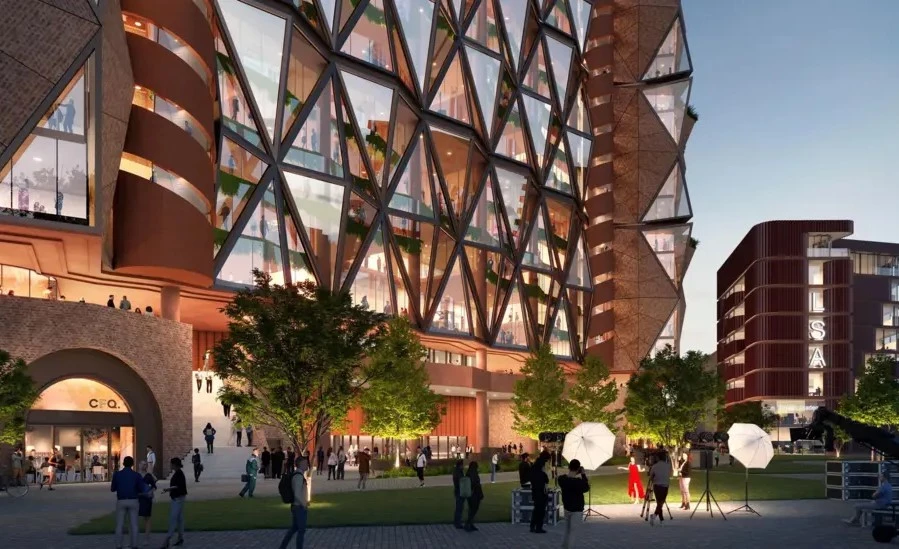
The scheme, led by developer Yoo Capital, will deliver a significant new hub for the UK’s creative industries. The project includes 11 purpose-built sound stages, alongside education facilities, public spaces, and 485 new homes, of which 243 will be designated as affordable housing.
A Landmark Development for Camden
Located on brownfield land earmarked for regeneration nearly a decade ago, the Camden Film Quarter represents one of the borough’s most ambitious redevelopment initiatives in recent years. Planning officers described the level of housing provision as “very rare,” underlining the scale and importance of the project within Camden’s wider housing strategy.
In addition to residential units, the development will introduce:
- New cycle lanes and pedestrian routes
- Public parks and landscaped open spaces
- Education facilities supporting over 500 students, in partnership with the National Film and Television School and the London Screen Academy
The scheme is also expected to generate approximately 1,365 jobs across construction and operational phases, positioning Kentish Town as an emerging centre for film, television, and creative industries.
Economic and Community Impact
Yoo Capital has described the project as a “world-class” addition to London’s film infrastructure, designed to deliver both commercial growth and community benefits. The integration of studio space with education facilities aims to support talent development while attracting major production companies to the area.
From a property perspective, the introduction of new homes, improved infrastructure, and employment opportunities is likely to enhance Kentish Town’s appeal as a residential hotspot, particularly for professionals working in creative sectors.
Local Concerns and Opposition
Despite its approval, the scheme has generated notable opposition. A total of 441 objections were submitted by residents and community groups, raising concerns over the scale of the development, environmental impact, and disruption during construction.
The Green Party, which represents the council’s opposition, has been particularly critical. Representatives described the project as “extreme” in scale, citing concerns around greenhouse gas emissions and the use of diesel vehicles during the building phase.
Additional objections have focused on:
- Environmental impact and carbon emissions
- Construction-related disruption
- Fire safety concerns linked to residential units located above a waste facility
The developer has responded by committing to mitigation measures, including exploring advanced waste screening systems to detect hazardous materials such as lithium-ion batteries.
Environmental Considerations
Council officers acknowledged that the project’s environmental impact would be “significant,” noting that projected emissions exceed current benchmarks. However, they also highlighted that the development is designed to achieve a 63% reduction in carbon emissions through enhanced energy efficiency measures.
Officials further clarified that existing emissions benchmarks are not strict targets, suggesting some flexibility in assessing large-scale developments of this nature.
Looking Ahead
With planning approval secured, the Camden Film Quarter is expected to play a key role in the borough’s future growth. While debate around its scale and environmental implications continues, the scheme represents a major investment in both housing delivery and London’s creative economy.
https://www.bbc.co.uk/news/articles/c3vy97w0ep5o
Source The BBC